- Thunderline Skates: The World's Fastest Roller Skates
- Raiju - The Legend Takes Form Raiju
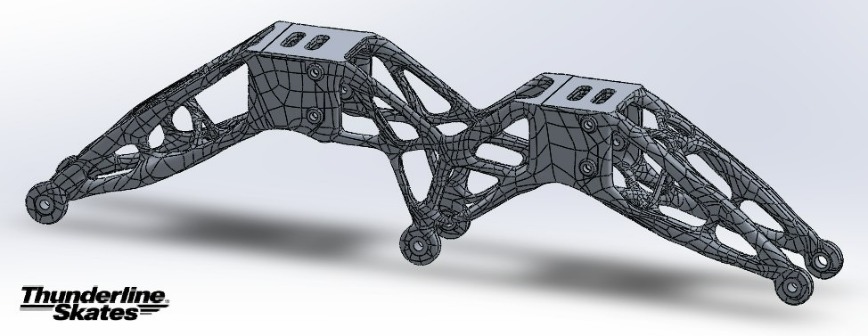
- How an Algorithm "Grew" The World's First Frame For a 3x200mm Wheel Configuration
- Organic. Alive. Perfect. Nature is a Genius Engineer, and AI is its Most Brilliant Student
- Raiju: Artificial Intelligence, Under Your Feet / Future-Forward Technology
- Birth Of a Legend: The Making Of The Thunderline Skates Raiju Frame
- Rusal RS-553: Aerospace-Grade Aluminum Alloy For Your Safety and Records
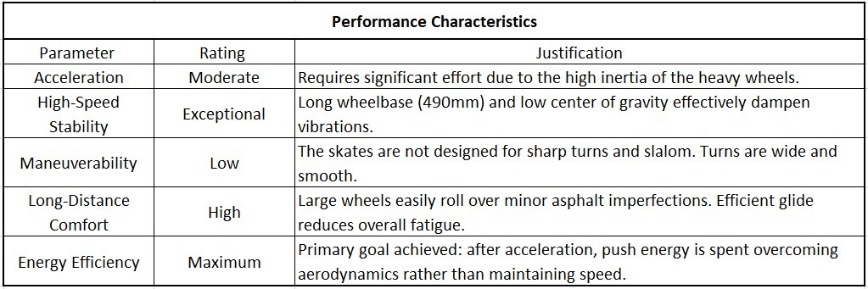
- Who is Raiju For? / Performance Characteristics
- "Engineering" Static Analysis Of The Raiju Frame Using Finite Element Analysis (FEA)
- Performance Calculations & Real-World Feel / Peak Speed On The Raiju
- The Experience That Awaits You
- The Gyroscopic Effect on The Raiju
- Attention: Raiju is Not Just Sports Equipment. It is an Experimental Platform
- Anthropometric Requirements: A Critical Safety Factor
- Detailed Analysis Of "Shadow"
- Why We Do Not Offer the Raiju Frame for Rent or Test Rides
- Ecosystem
- Thunderline Skates: Brand Philosophy
- Pre-Order Now
THUNDERLINE SKATES: THE WORLD'S FASTEST ROLLER SKATES
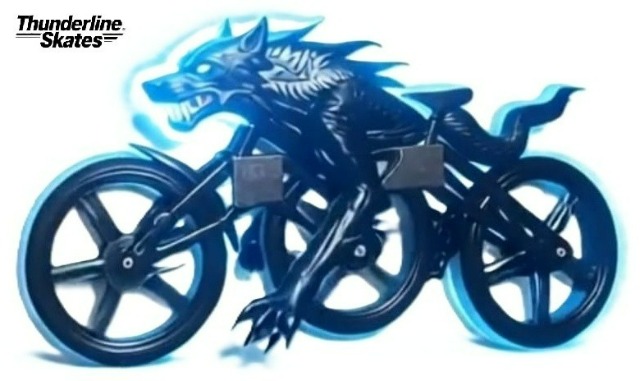
When the Thunder God Raijin beat his drums, his loyal companion - the fierce and untamable Raiju - descended to earth. Ancient scrolls tell of a creature born from celestial fury. Raiju, the thunder beast, a being woven from lightning, its roar tearing through the heavens. It manifested as a flash, crashing down upon the earth with a peal of thunder. Its claws sparked lightning, and its speed defied time itself. For centuries, it existed only in legends. Until we decoded the formula of its speed.
The Thunderline Skates / Raiju embodies this spirit. Not merely speed, but elemental fury captured in perfect form. It's the skin of the mythical beast wrapped around your feet. Speed that once belonged only to gods.
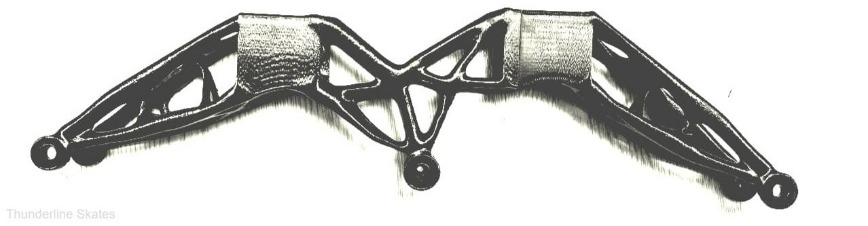
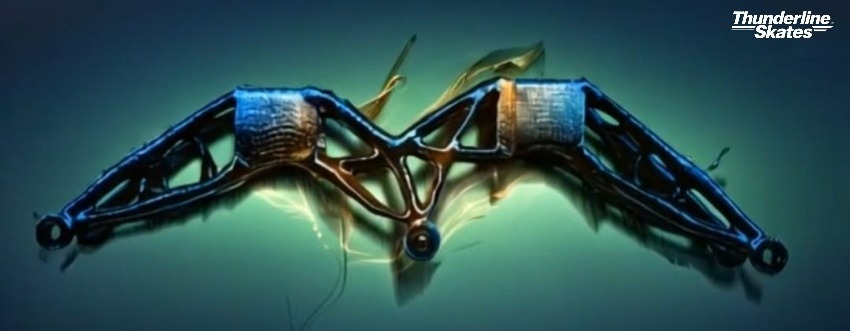
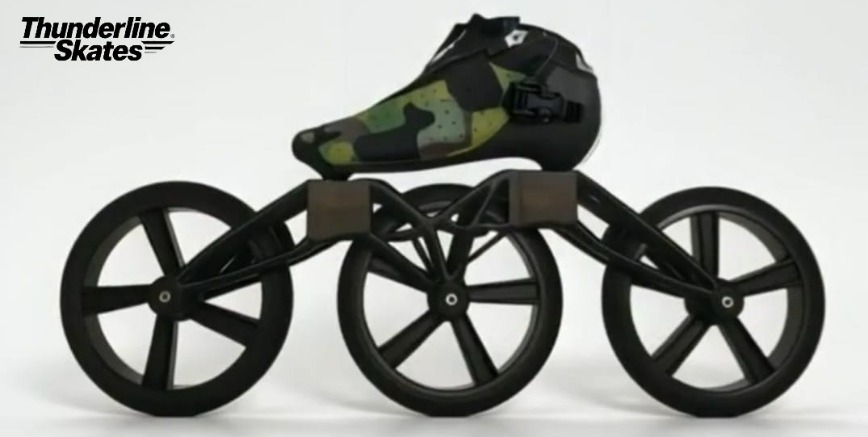
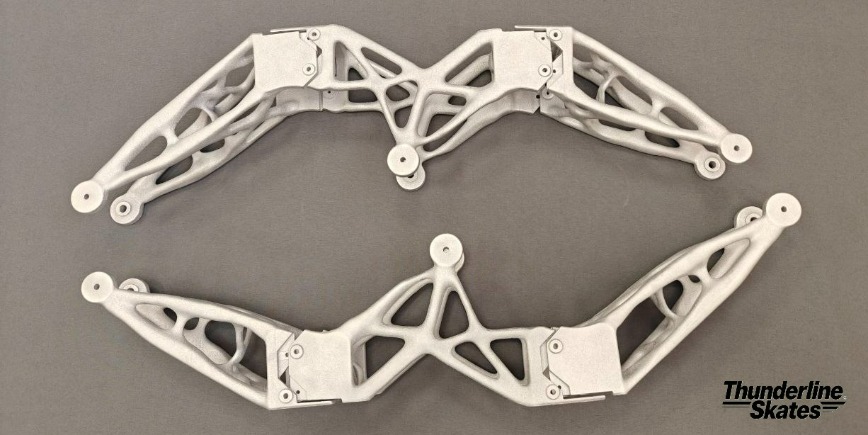
We awakened the spirit. Through generative design algorithms, we calculated the very geometry of lightning. Using 3D printing, we grew its steel muscles and living nerves in aluminum. Every curve of this frame is not the result of engineering calculation, but the frozen trajectory of the thunder beast's movement.
This is not merely skating equipment. It's a conduit of ancient power, where your feet become Raiju claws and the asphalt transforms into the sky for its run.
Tame the legend. Ride the lightning. Feel Raiju ancient power pulse with your every motion, turning asphalt into its personal sky. Become the one upon whom the Thunder Beast descended from the heavens. Let every ride be a new myth, born here and now.
- Beyond Standard. Beyond Speed. Your mark on the asphalt starts here.
Picture this: you're floating above the ground, the wind rushing into your lungs, your body feeling every molecule of velocity. You're not running—you're flying. The asphalt beneath you becomes a blur, and every move isn't just a push, but a pulse igniting a chain reaction of speed. This isn't science fiction. This is the feeling of your first ride on Thunderline Skates / Raiju.
Raiju: The Frame That Won't Ask You to Adapt. It issues a challenge. To your skill. To your limits. To your very idea of what's possible.
- Ai, 3D Printing & Giant Wheels: Thunderline Skates' Formula for Future Speed
Imagine a 200mm wheel rolling over a pavement crack as easily as an SUV over a curb. Minor imperfections simply don't exist for it. Your energy isn't wasted on overcoming obstacles but is channeled entirely into pure speed. Rolling resistance drops by up to 40% compared to 125mm wheels. You push, and then you... glide. The motion becomes incredibly efficient, perfect for marathon distances.
Raiju is an engineering statement. Creating a frame for 200mm wheels isn't about scaling up an old design. It's about overcoming immense torsional and bending stresses that would compromise conventional frames. This is where generative design and metal 3D printing prove their worth - not as marketing terms, but as fundamental necessities. Creating a frame strong enough yet light enough for wheels of this size would be nearly impossible through traditional methods without significant weight penalties. AI-driven design and additive manufacturing provide the optimal solution.
This defines its specialized nature Thunderline Skates.
Thus, the combination of Generative Design + Metal 3D Printing + 200mm Wheels forms the very core of this revolution.
Without wheels of this scale, the frame would remain technologically interesting, but wouldn't radically rewrite the rules of the game. It's the unprecedented wheel size, enabled by the frame's unique strength, that makes this product truly groundbreaking.
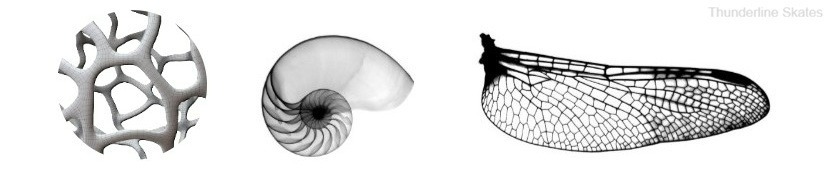
NATURE IS A GENIUS ENGINEER, AND AI IS ITS MOST BRILLIANT STUDENT.
Trabeculae are architectural elements in living organisms—lattice-like beams or partitions that form a supporting framework inside bones or plant structures. Their kcharacteristics are:
The bones in our body are a blueprint of ideal design: incredibly strong and light. Generative design algorithms have replicated this principle, creating an "anatomy of speed"—a frame where every "bone" of the chassis works for your movement. This isn't just a piece of metal. It's the skeleton of your future record, grown from aluminum dust and computational power.
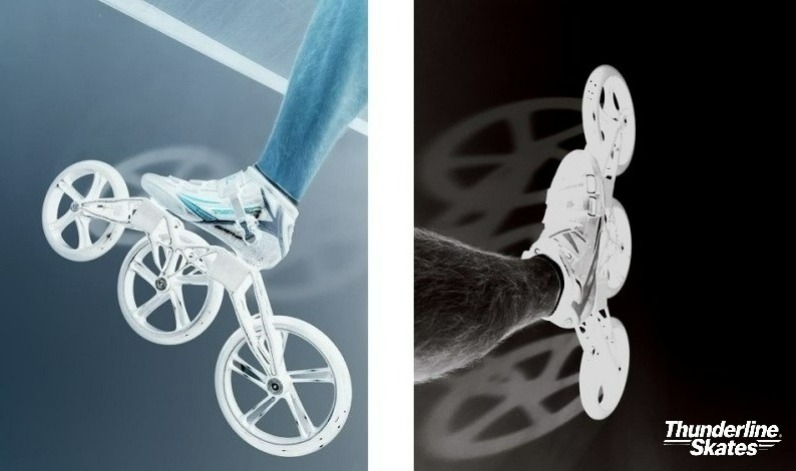
· Distributes material only in high-stress zones, ensuring strength where it's needed.
· Minimizes weight without the slightest sacrifice in stiffness or durability.
This isn't just a frame.It's an intelligent system embodied in metal.
*FEA (Finite Element Analysis) — A computer-based simulation method used to predict how a product will react to real-world forces such as vibration, heat, and physical stress. It allows engineers to optimize the design for strength, stiffness, and durability before a prototype is ever built.
*SLM (Selective Laser Melting) — A metal 3D printing technology where a high-power laser fuses fine metal powder particles together layer-by-layer. This enables the creation of complex, high-strength, lightweight parts that are impossible to manufacture with traditional methods.

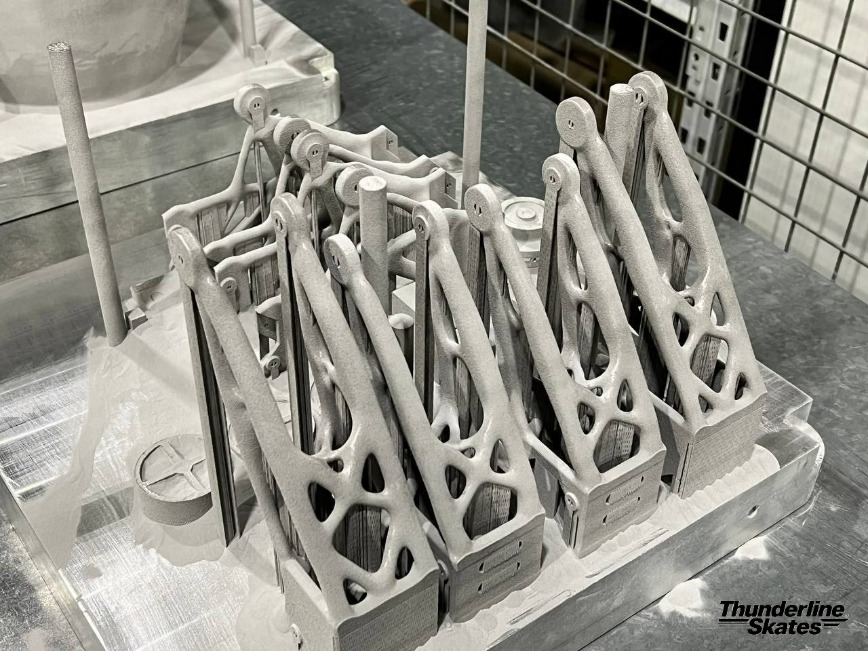
Every Raiju frame is not merely a part; it is the physical embodiment of speed, cultivated from digital intent and aerospace metal. We reveal each stage of this complex alchemical process where data transforms into dominant supremacy.
· Ultimate Tensile Strength (after heat treatment): ~475-480 MPa.
· This is a value comparable to some grades of steel, yet with the density of aluminum. The frame possesses phenomenal resistance to impact and static loads.
· Scandium is a rare-earth metal that creates super-strong and thermally stable compounds within the aluminum structure.
· Result: The alloy achieves high plasticity (elongation at break ~10%) combined with strength. This means the frame will not be brittle; it will absorb and dissipate impact energy rather than shatter.
· Rusal RS-553 withstands an enormous number of load cycles without developing microcracks. For the rider, this directly translates to long-term durability and safety, especially under constant high-speed loads and vibrations.
· This alloy was specifically designed for additive technologies. It enables the generative design method to create the frame's highly complex lattice structure without any loss of strength characteristics. Such geometry is impossible to replicate using traditional methods.
Strength: Very High
Plasticity: High (ductile fracture)
Fatigue Strength: Exceptional
Impact Behavior: Absorbs and dissipates energy
- Standard Aluminum (AlSi10Mg):
Strength: Medium
Plasticity: Medium
Fatigue Strength: Good
Impact Behavior: May deform under impact
- Carbon Fiber:
Strength: Very High (but anisotropic*)
Plasticity: Low (brittle fracture)
Fatigue Strength: May degrade over time
Impact Behavior: Risk of hidden delamination and sudden failure
· Technology Proven in Extreme Conditions: This alloy is used where failure is unacceptable—in critical components of aircraft and race cars.
· Full Quality Control: Every powder batch undergoes strict checks, and the printing process followed by stress-relief annealing ensures the finished frame has stable and predictable mechanical properties.
The Bottom Line: By choosing the Raiju frame made from Rusal RS-553 alloy, you are not just choosing aluminum; you are selecting a modern engineering material that offers a benchmark balance of strength, reliability, and durability, ensuring maximum confidence at any speed.

Peak Speed on the Raiju: A Mathematical Feasibility Study
This mathematical analysis assesses the feasibility of reaching 85 km/h on the Raiju skates with 3x200mm wheels. For simplicity, the calculation focuses on the key physical constraint at high speeds: aerodynamic drag.
Assumptions and Input Data:
· Target Velocity (V): 85 km/h = 23.6 m/s
· Frontal Area (A): 0.4 m² (assuming a low, aerodynamic tuck)
· Drag Coefficient (Cx): ≈ 0.7 (for a human body in a crouched position)
· Air Density (ρ): 1.225 kg/m³ (standard at sea level)
· Rolling Resistance & Bearing Losses: Neglected, as their contribution (5-10%) is significantly smaller than aerodynamic drag at these speeds.
1. Calculation of Aerodynamic Drag Force (Fₐ)
Using the drag force equation:
Fₐ = ½ * ρ * V² * A * Cx
Substituting the values:
Fₐ= 0.5 * 1.225 * (23.6)² * 0.4 * 0.7
Fₐ= 0.5 * 1.225 * 556.96 * 0.4 * 0.7
Fₐ ≈ 95.5 N (Newtons)
2. Calculation of Required Mechanical Power (P)
Power required to overcome this force is:
P = Fₐ * V
P = 95.5 N * 23.6 m/s
P ≈ 2254 W
(This is approximately 3.1 horsepower)
3. Interpretation and Feasibility Analysis
2254 W is an exceptionally high power output.
· For context:
· A professional cyclist's peak sprint power can reach 1500-2000 W, but only for a few seconds.
· The sustained power output for a world-record hour cyclist is approximately 400-450 W.
Conclusions:
1. Theoretically Possible: Accelerating to 85 km/h on a flat surface is possible, but only as a brief, all-out sprint lasting a few seconds.
2. Practically Unsustainable: No athlete can maintain this speed for even a minute. The required power output is far too high.
3. Prerequisites for Achievement: Reaching this speed would require:
· A perfect aerodynamic tuck (potentially more aggressive than assumed).
· World-class peak muscle power and conditioning.
· A perfectly smooth surface and absolutely zero headwind.
Therefore, 85 km/h represents an extreme, peak performance ceiling, attainable only momentarily under ideal conditions. For realistic training or racing, a cruising speed in the 45-60 km/h range is more indicative of performance, where the required power (400-900 W) aligns with the capabilities of trained athletes.
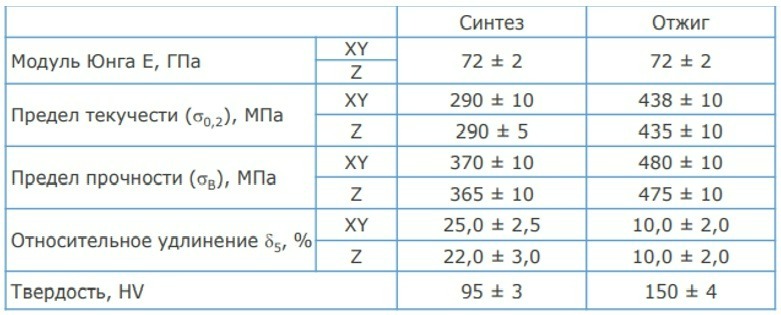
1️⃣ Young's Modulus (E), GPa
· What it is: The stiffness of the material. It measures how strongly it resists elastic deformation (stretching/compression). The higher the value, the stiffer the material.
· The Numbers: Consistent at 72 ± 2 GPa across all conditions and directions.
· Analysis:
· This is the classic figure for aluminum alloys (typically 68–72 GPa).
· Most Importantly: Annealing does not change stiffness. Young's Modulus is a material constant, determined by its chemical composition, not by heat treatment. The frame will be equally stiff, whether printed or annealed.
· The properties in the XY and Z directions are virtually identical (72±2) — this is an excellent result! It means the printing technology yields isotropic properties in terms of stiffness.
· The Numbers:
· As-Built: 290 ± 10 MPa (consistent in XY and Z).
· Annealed: 438 ± 10 MPa (XY), 435 ± 10 MPa (Z).
· Analysis:
· Annealing INCREASES STRENGTH by 1.5 times! (from ~290 to ~438 MPa). This is precisely why it's a critical step. The frame becomes one and a half times stronger against bending and torsion after heat treatment.
· The actual yield strength of the RS-553 alloy is 435–438 MPa. Technically, this value should be used for safety factor calculations.
· However, to ensure purity in our analysis, we deliberately used a conservative value of 400 MPa — slightly below the material's real-world characteristics. This is our "safety margin buffer," designed to compensate for theoretical risks such as minor inhomogeneities in the material structure or micro-deviations during heat treatment.
3️⃣ Ultimate Tensile Strength (σ_B), MPa
· The Numbers:
· As-Built: ~370 MPa.
· Annealed: 480 MPa (XY), 475 MPa (Z).
· Analysis:
· Again, a significant increase after annealing: a +30% gain in tensile strength.
· Important: Fracture occurs at ~480 MPa, while yielding begins at ~438 MPa. This means that after the material has "yielded" (ceased being elastic), it still has a small reserve before breaking. This is a good thing — it provides a warning (deformation) before a potential failure.
· The Numbers:
· As-Built: 22–25% (very high ductility).
· Annealed: 10.0 ± 2.0 %.
· Analysis:
· This is the only parameter that decreases after annealing. However, this is not a flaw; it's expected. We have essentially "traded" some ductility for greater strength.
· 10% is still an excellent value for such a high-strength alloy. Standard, non-heat-treated aluminums typically range from 5–8%. We retain enough ductility so the frame can bend slightly under extreme loads, rather than shattering like glass.
· The Numbers:
· As-Built: 95 HV (relatively soft).
· Annealed: 150 HV.
· Analysis:
· Hardness has increased by a factor of 1.6.
· This means that after annealing, the frame is much more resistant to scratches, gouges, and wear. The surface becomes more "glass-like" and hard.
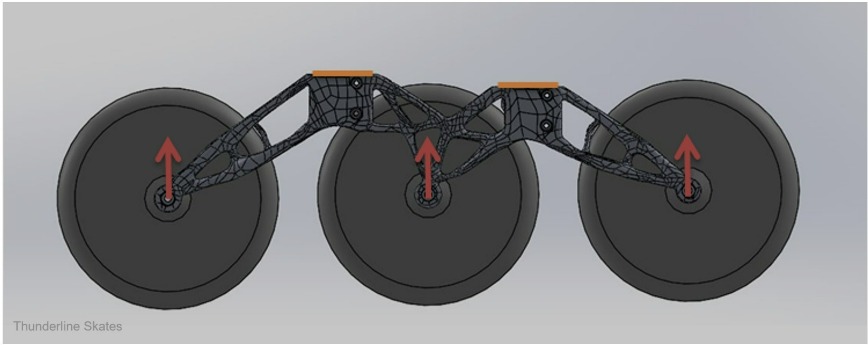
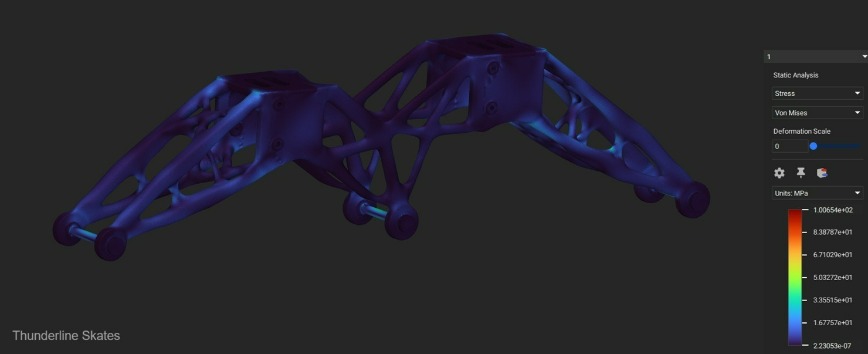
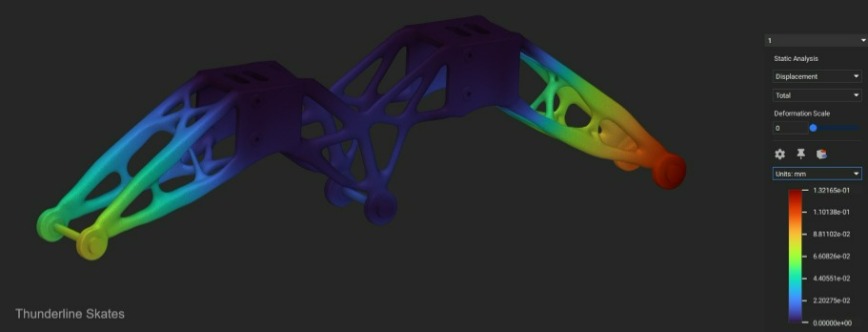
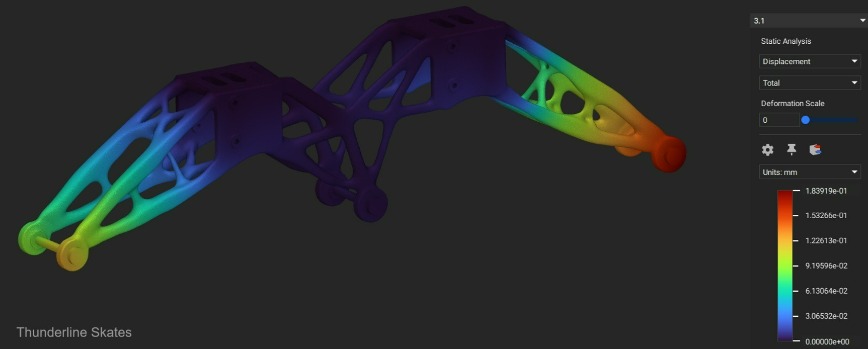
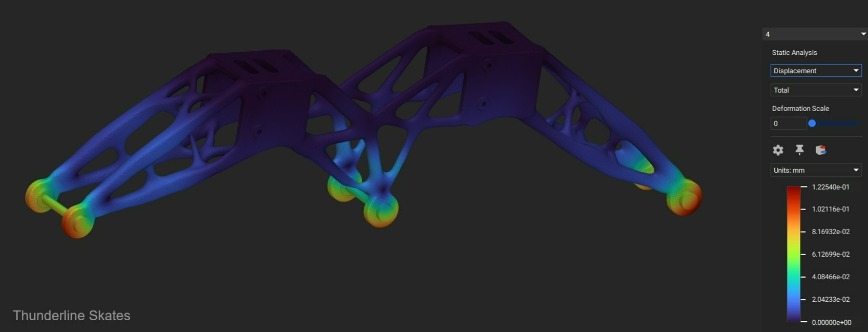
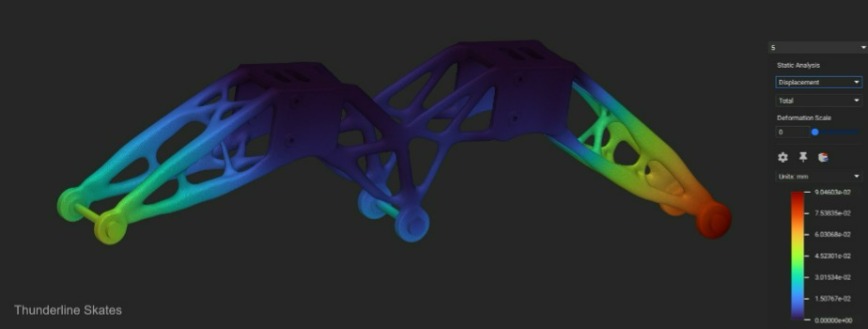
Maximum displacement: Just 0.13 mm.
Safety margin ≈ 4 — the frame is four times stronger than required for static weight.
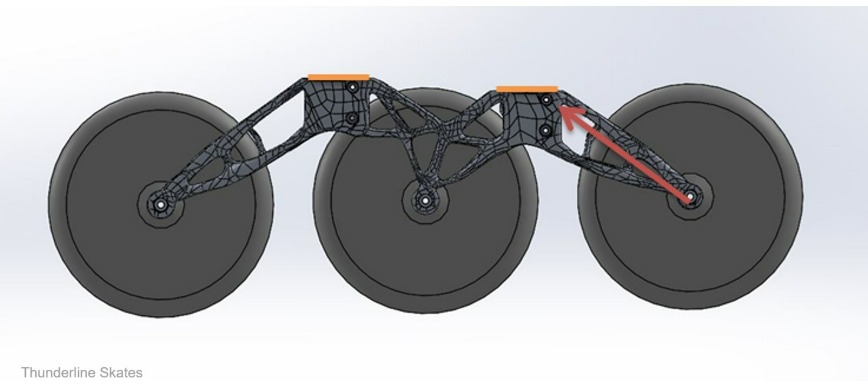
2. 45° Angled Load (Simulating Turns and Push-Offs)
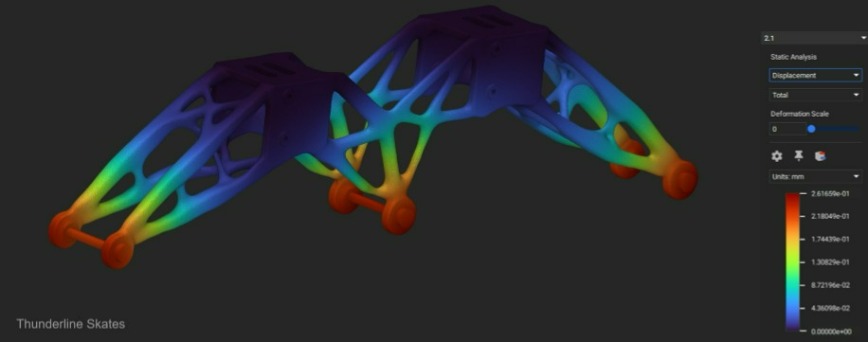
Two separate calculations with opposing force directions were performed to test the frame against multidirectional forces.
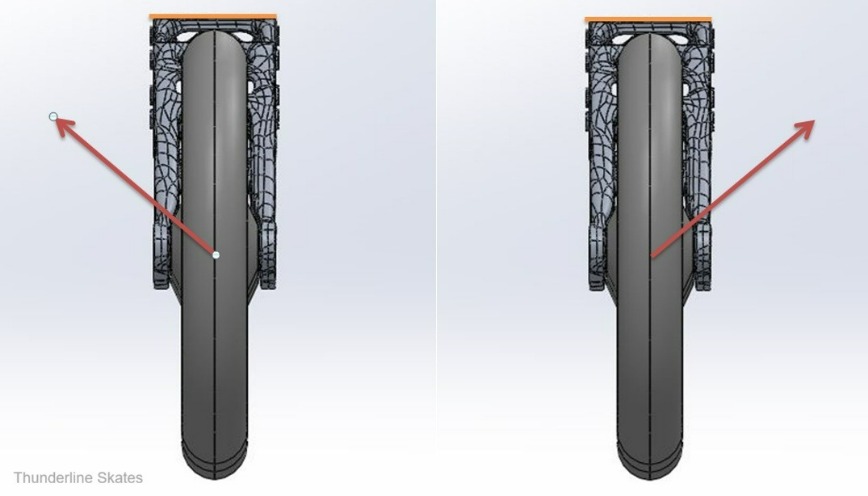
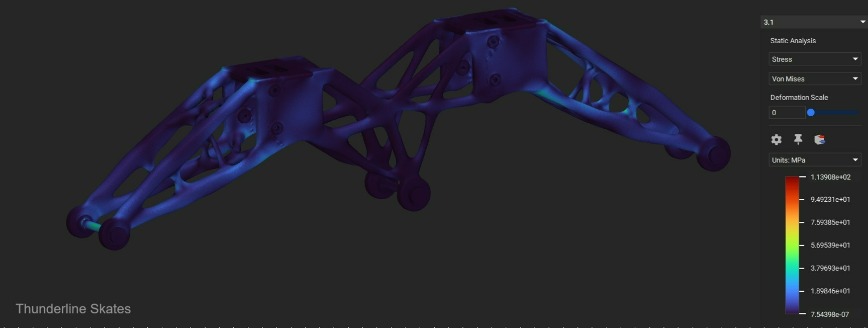
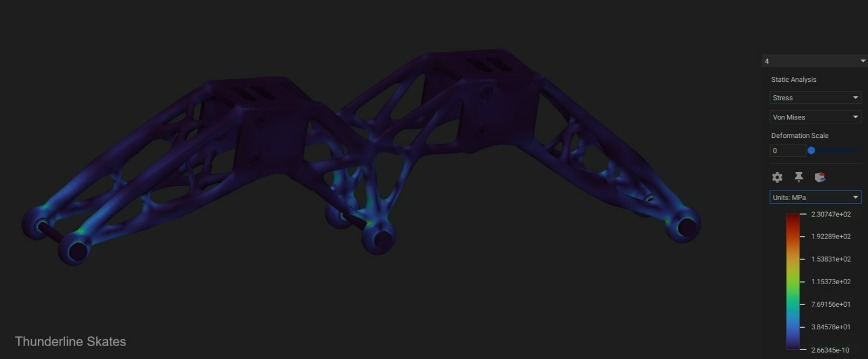
Analysis 2.1
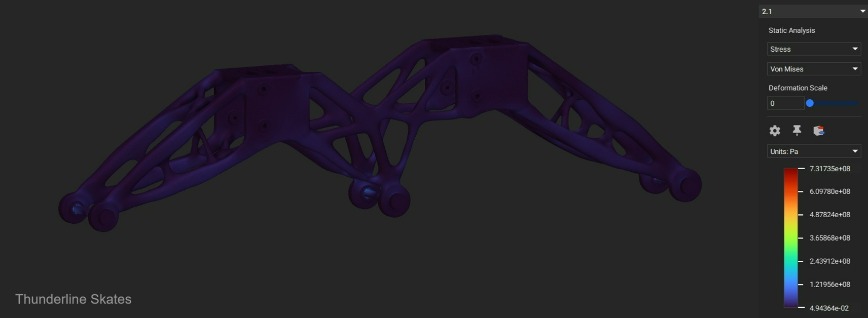
Reliable values are approximately 600–650 MPa.
The frame experiences local stresses of approximately 150 MPa.
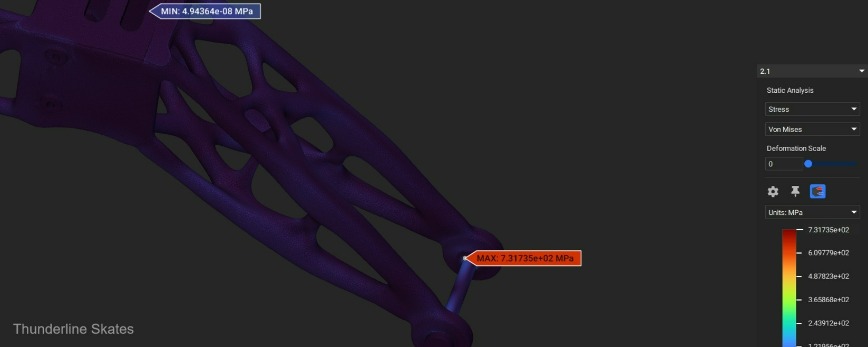
Analysis 2.2
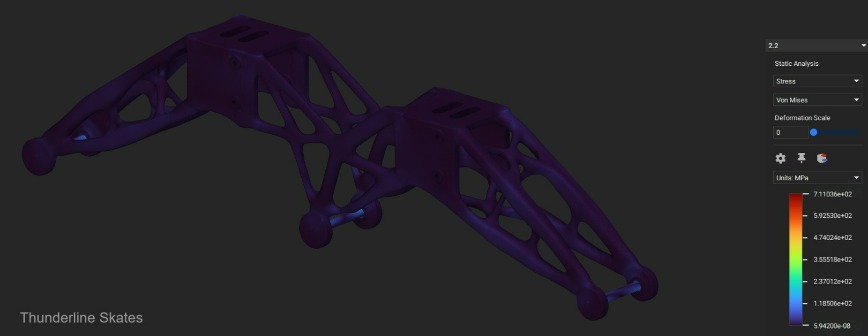
· Reliable values are approximately 600–650 MPa.
· The frame experiences local stresses of approximately 150 MPa.
⚙️ Why This Matters — and Why It's Good
Different Materials, Different Allowable Stresses
· S2 Steel (Axles) — an ultra-strong tool steel. Its ultimate tensile strength is approximately 1000–1200 MPa, with a yield strength of around 800–900 MPa.
· 600–650 MPa for steel is a working, permissible load (safety margin ≈ 1.3–1.4).
· RS-553 Aluminum (Frame) — its ultimate tensile strength after heat treatment is approximately 480 MPa.
· 150 MPa for aluminum is only 30% of its ultimate strength — a huge safety margin.
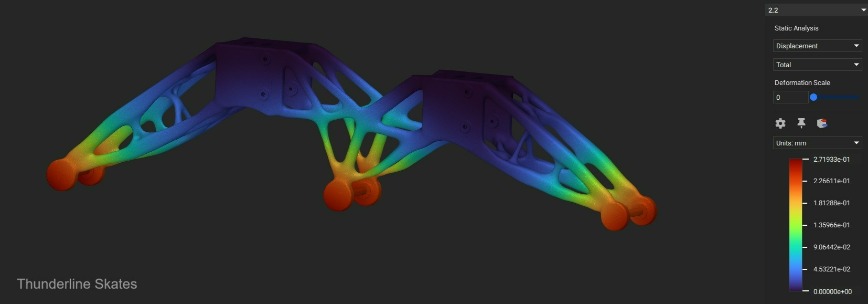
Conclusion: Withstands the load.
Frame safety margin ≈ 2.6 — the structure remains elastic even under lateral loads.
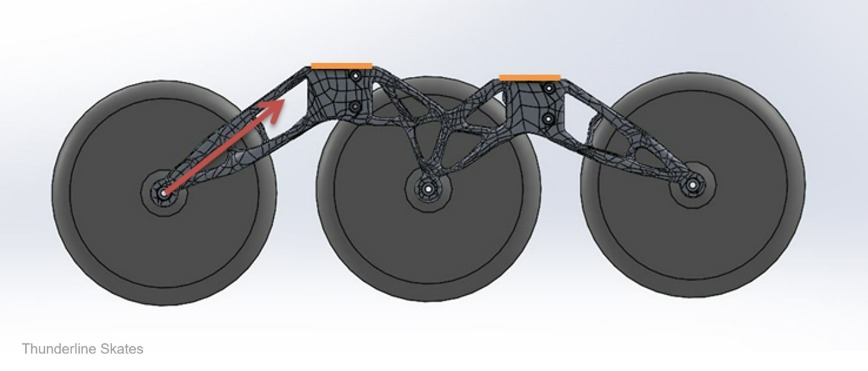
4. Torque on Each Axle (30 N·m)
An even more demanding scenario — simultaneous torsion of all three wheels.
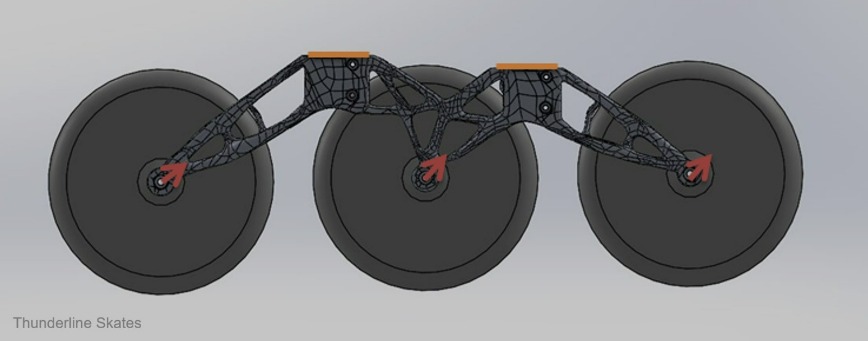
· The calculated load of 30 N·m is extremely high
· For reference: 30 N·m on a wheel axle corresponds to a force of 300 kgf applied at the end of a 10 cm lever arm (the wheel radius). In reality, such forces do not occur: the maximum torques during slide braking or hitting an obstacle are several times lower.
· This means that real-world loads are lower than the calculated ones, so the actual in-service safety margin will be significantly higher than 1.7.
· In the automotive industry, suspension components, control arms, and steering knuckles are often designed with safety margins of 1.5–2.0 for peak loads.
· In aviation, a safety margin of 1.5 is acceptable for non-critical parts. For critical components, it is 2.0 or higher.
· The Raiju frame is not an airplane wing; it is a piece of sports equipment, albeit a premium one. A safety margin of 1.7 indicates that the structure is optimized for weight while remaining reliable.
· The key point: failure will not start with the frame
· This same calculation shows that the axles experience stresses up to 730 MPa. For S2 steel, this is also acceptable (yield strength ~800–900 MPa, safety margin for the axles ≈ 1.1–1.2). However, axles are inexpensive, replaceable parts.
· In an overload situation, the axles will fail first, while the frame survives. This is sound engineering logic: the most expensive and complex components are protected by "sacrificial" elements.
"A safety factor of 1.7, with a yield strength of 450 MPa and a calculated stress of 231 MPa, guarantees that actual failure would only occur under a load 1.7 times higher than the design load. Given that the design load of 30 N·m is deliberately set well above any real-world scenario, the actual in-service safety margin is at least 2.5–3.0."
· The frame does not have excess mass (no superfluous metal).
· It was designed with a true understanding of real-world loads.
· The most expensive element (the frame) is protected from failure.
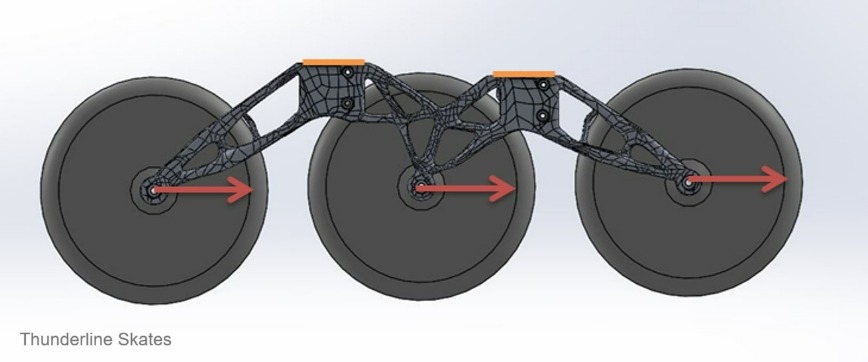
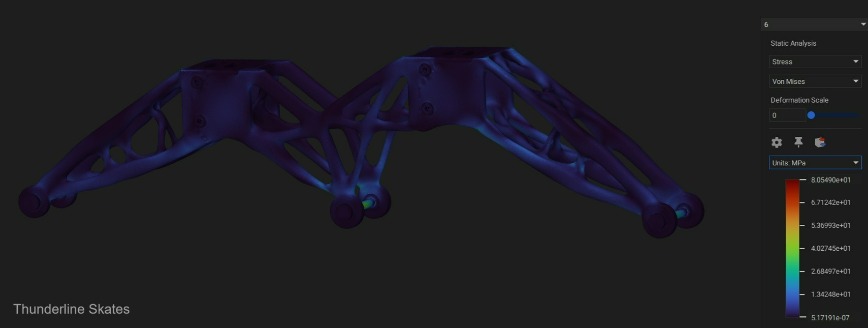
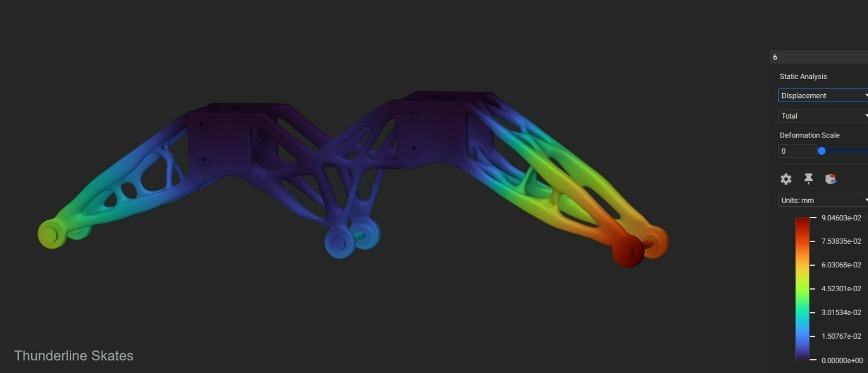
This tests the frame's resistance to bending in the longitudinal plane — for example, during sudden braking or hitting an obstacle.
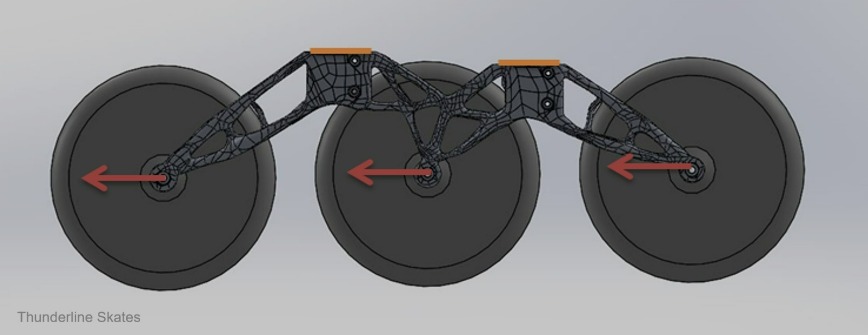
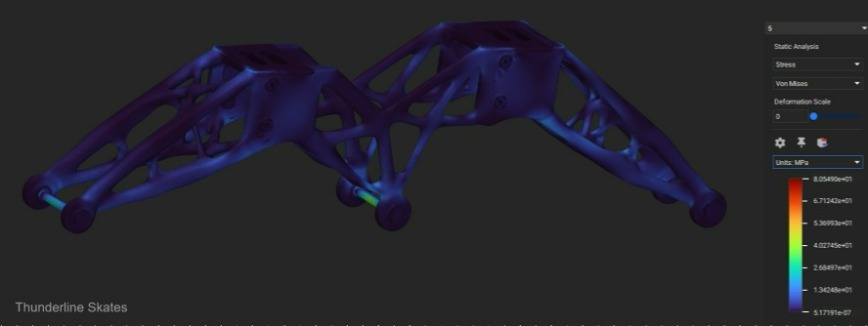
6. Longitudinal Bending Moment from the Last to the First Wheel (70 N·m)
This tests the frame's resistance to bending in the longitudinal plane — for example, during sudden braking or hitting an obstacle.
1. The Feeling of "Legendary Power" (The Psychological Edge)
A unique style.The futuristic, algorithm-generated design guarantees you won't go unnoticed. You'll stand out not just for your speed, but for the sheer technological prowess of your equipment.
You will be standing on skates that are one-of-a-kind. The very fact of owning such an artifact, knowing the technology within, provides an immense emotional charge. You won't feel like just a skater; you'll feel like the pilot of an experimental machine.
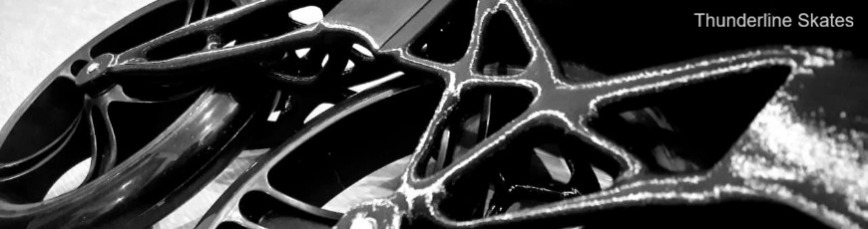
The gyroscopic effect from the 200mm wheels is not a minor detail; it's a fundamental physical force that will dictate your interaction with these skates. It fundamentally changes the system's behavior. Here’s a detailed breakdown of its benefits and costs.
Practical Conclusion & Recommendation:
· The effect will be noticeable, but not powerful enough to violently wrench your foot away and cause a fall on its own.
· The primary danger is not the gyro, but the sheer weight and inertia. The biggest challenge when repositioning your free foot is the pure inertia of the heavy setup that you must stop and redirect.
· What should you do? Consciously practice smooth, controlled movements with your free foot during your first sessions. Feel the resistance, and your body will naturally find the new, optimal movement pattern.
Final Word: Yes, you will feel that your feet have become "smarter" and resist chaotic movements. But this is not a dangerous phenomenon; it's another feature that makes these skates unique and demands a higher level of skill for complete mastery.
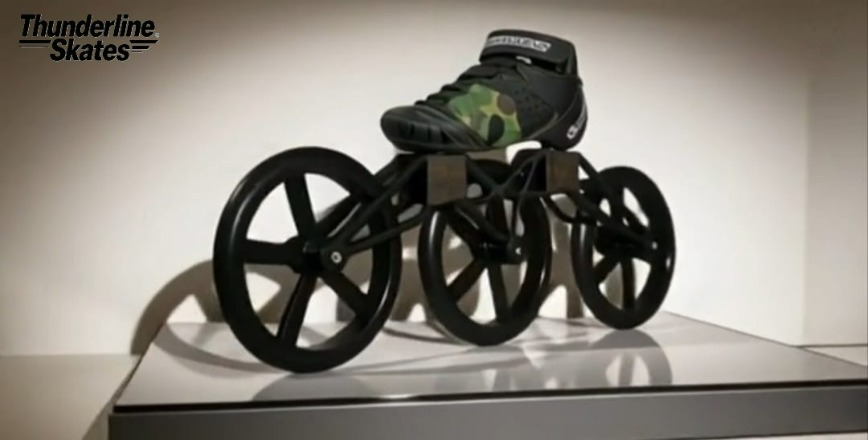
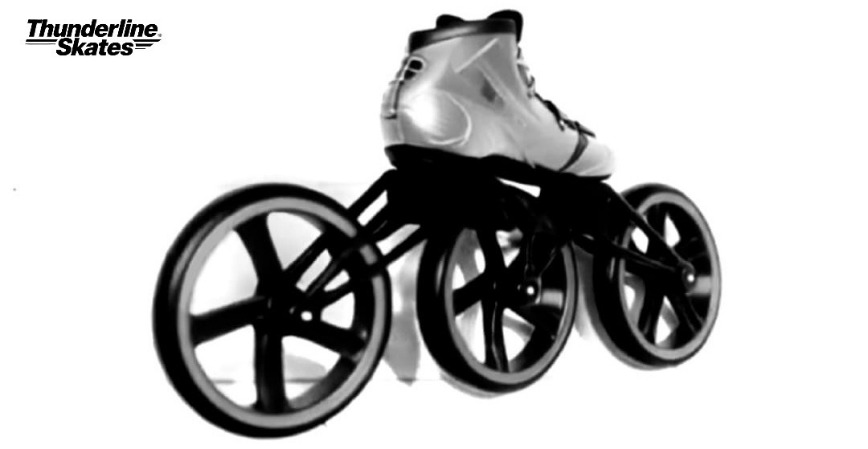
The minimum recommended height for safe and effective use is 165 cm (approx. 5'5"). This requirement is dictated by the physics of control:
· Managing the high center of gravity requires sufficient leg length to generate the necessary muscular leverage.
· Counteracting the gyroscopic effect and inertia is only possible with the corresponding leverage provided by a height of 165 cm and above.
Use of the Raiju frame by riders below the recommended height is deemed unsafe, significantly increases the risk of loss of control and falling, and is undertaken solely at their own risk. Your safety is our priority. Ensuring your physical parameters match the equipment's capabilities is the first and most crucial step to conquering speed.
This is no longer just sport. It is a practice of mindfulness at the edge of physics. All these features are not walls on your path. They are doors. And behind each one awaits a new, undiscovered sensation, inaccessible to those who ride anything ordinary. You are turning your routine into a legend. One ride at a time.

Choosing the Raiju frame is not simply about purchasing new equipment. It is a conscious decision to transition to a fundamentally different level of skating, one that requires a complete recalibration of skills, mindset, and muscle memory.
2. The Raiju Frame is a Specialized Tool, Not a Universal Product.
It is engineered for specific conditions (perfect asphalt, straight tracks, marathons) and demands particular preparation from the rider. A brief test ride will not allow one to appreciate its true advantages—phenomenal roll and stability over long distances—but will instantly reveal its challenges (maneuverability, weight) to an unprepared user. This creates a biased and negative first impression.
3. Responsibility for Reputation and Your Investment.
A negative experience, gained in haste and without proper preparation, almost inevitably leads to negative reviews that discredit not only the frame but the very philosophy of the product. Furthermore, we want every purchased frame to last long and bring joy. Damage to the frame during a "test" (scratches, chips, hidden stresses from a fall) calls into question its further safe operation and creates conflict situations.
4. A Filter for Serious Intent.
This policy is a deliberate filter. It is designed to identify those who are prepared to approach the transition to this new platform with the utmost seriousness: to independently study all technical documentation, honestly assess their skill level, review instructional materials, and make a conscious purchase decision. Such a user values not only the product but also their own progression.
The Thunderline Skates / Raiju frame is the result of a symbiosis between cutting-edge digital technologies and living human experience. We have joined forces with the best industrial partners to transform a digital dream into a flawless physical object.
· The SPIN Factory provided engineering power, precision calculations, and the ability to "grow" the most complex geometry.
· The RollerStar Skate School contributed sports expertise, an understanding of skating nuances, and rigorous testing on actual tracks.